Your cart is currently empty!

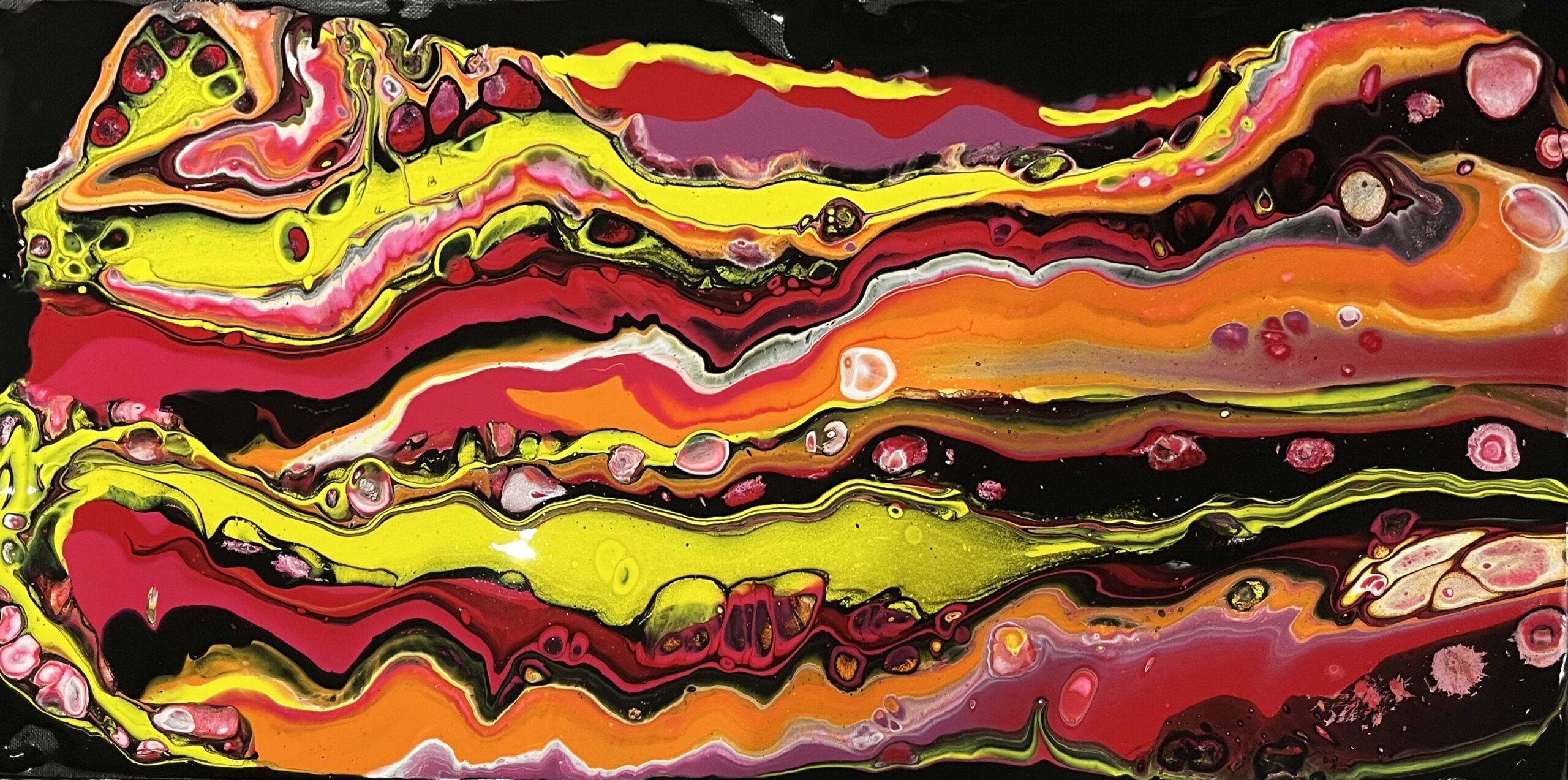
What is Fluid Art?
Contrary to what you may come across on social media Fluid Art was not invented in 2008 by a Youtuber or launched on Instagram in 2012. The technique has actually been with us for at least 90 years.
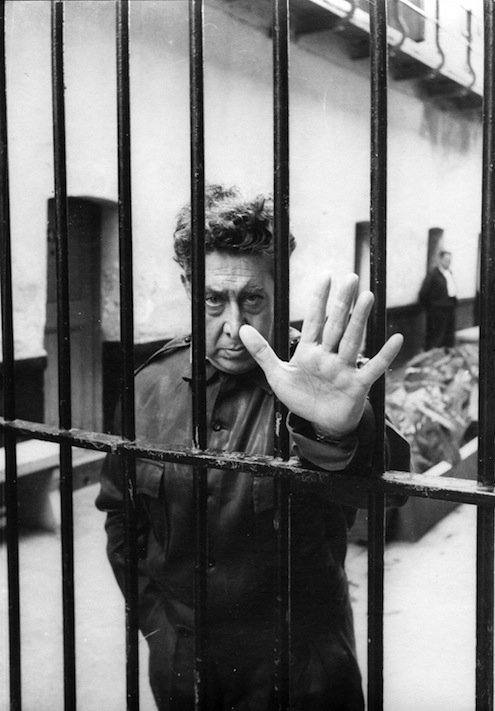
David Alfaro Siqueiros, Lecumberri, México, D.F., 1960. Archivo fotográfico Héctor y María García.
Art historians point to David Alfaro Siqueiros (1896-1974) the famed Mexican muralist, experimental artist, revolutionary, political prisoner and exile, as the principal innovator. Before delving into his art experiments that led to fluid art, it is important to note his huge contribution to the world of art and his involvement in the volatile socio-political upheaval during the Mexican Revolution.
Siqueiros is recognized as one of the three great pioneers and masters — alongside Diego Rivera and Jose Clemente Orozco — of social realism art and monumental muralism in Mexico in the 1920-1950s. From early on Siqueiros was often actively in the political discourse of the time, his radical Marxist Communist writings and art first endeared him to the authorities, but later would lead to his expulsion from Mexico.
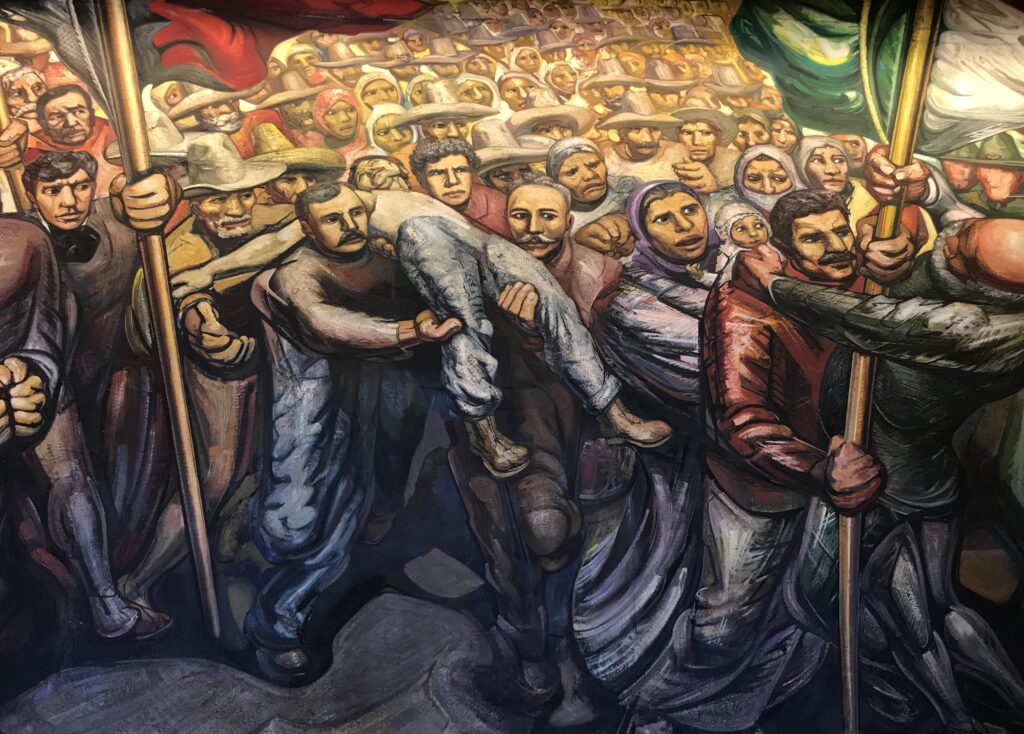
Dal Porfirismo a la Revolucion (detail) (1964), David Alfaro Siqueiros, Museo Nacional de Historia, Mexico City, Mexico.
During his political exile that began in Los Angeles in 1932, Siqueiros joined an artist collective that explored radical painting techniques using modern substances and tools, such as new paint formulations, spray guns and projectors, which he would apply to his new murals. Following a move to New York City in 1936 he founded the Experimental Workshop, a political art group in preparation for the 1936 General Strike and May Day parade. A young Jackson Pollock attended the workshop where he helped build parade floats, and, perhaps more importantly, learned new painting techniques from Siqueiros. This directly led to Pollock’s (in)famous pour and drip art works that have since become synonymous with the American abstract expressionism movement.
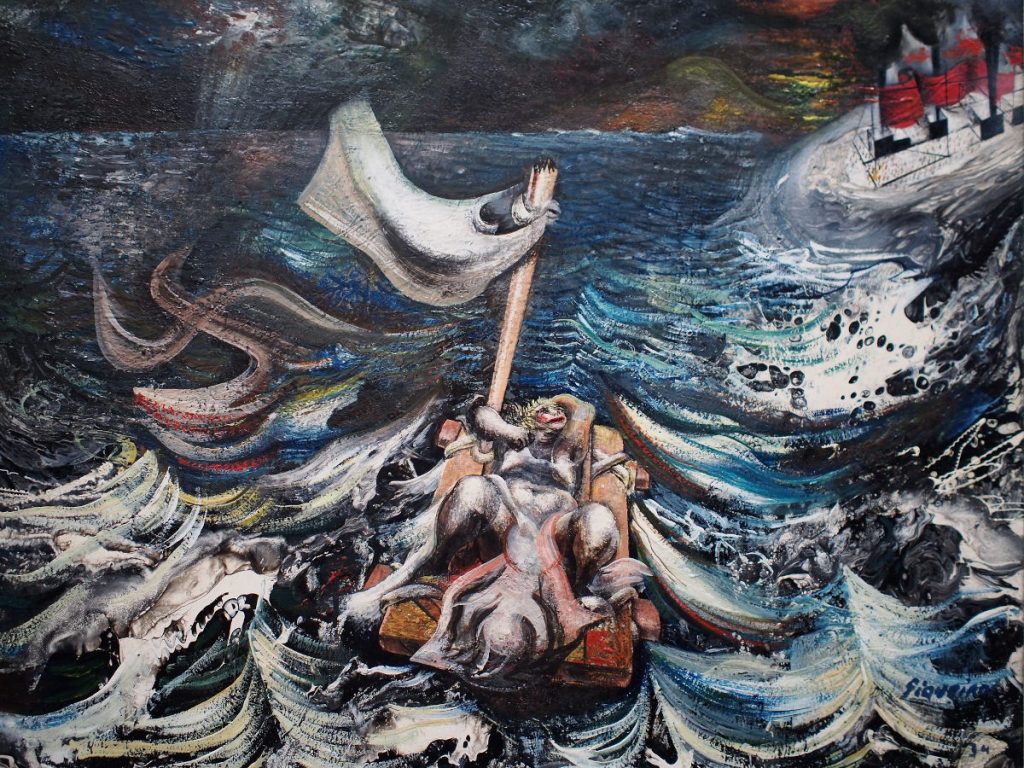
El nacimiento del fascismo (The Birth of Fascism) (1936), David Alfaro Siqueiros.
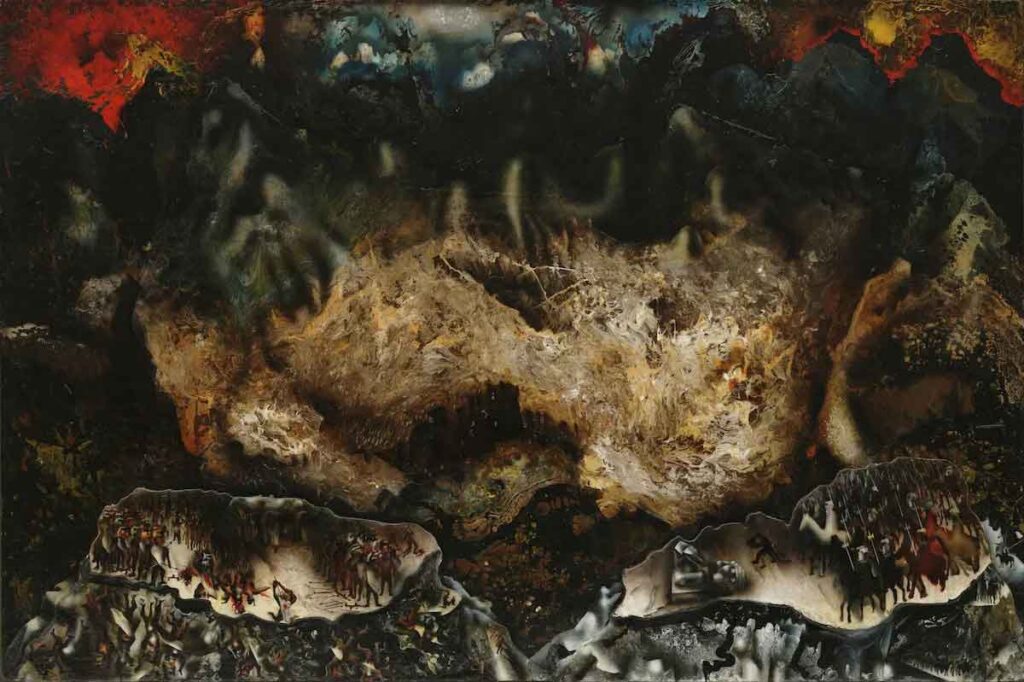
Collective Suicide (1936), David Alfaro Siqueiros, Museum of Modern Art, New York.
It was during this Experimental Workshop that Siqueiros discovered and refined what he would later call “controlled accidental painting” and “dialectical realism“. He poured two or more layers of differently colored paints over each other on a canvas laid flat on the floor. Importantly, the different colors of paint also had different densities. He found that the paint colors would intertwine — but not completely mix — and form vivid, dynamic patterns, which he described as “the most magical fantasies and forms that the human mind can imagine.” He employed this technique to contract the seascape in the Birth of Fascism and landscape in Collective Suicide.
Aside from his murals Siqueiros usually painted on wood board or linen canvas. He would prime the surface with a white primer or gesso and then lay down a neutral (usually reddish-brown) ground color. Over this he would pour and tilt thin layers of oil-based colors, both industrial enamel and lacquer. Siqueiros often used turpentine or other industrial solvents to thin his paints.
Unpredictability was key to Siqueiros’ Fluid Art technique. But two important variables gave him some degree of control over the painterly chaos: paint density and paint viscosity. Using paints with different densities allowed colors to move up and down relative to one another — a more dense paint laid over a less dense one would sink. In addition, paint viscosity also played a critical role in defining the final composition. A thin paint consistency created subtle cellular and/or feathery effects. A thicker paint consistency kept adjacent colors more separated leading to bolder, more defined patterns. Physicists and materials scientists have even studied these accidental painting effects — it all boils down to fluid dynamics caused by Rayleigh–Taylor instabilities.
Since the pioneering days of Siqueiros and Pollock many fluid artists have embraced similar techniques and added their own twists with new tools and materials. Though most artists now prefer to use acrylic over oil-based paints for ease of clean-up, non-toxicity and environmental concerns.